
Financial institutions
Valuation and Quality of Earnings for SBA acquisition lenders.
Chief provides valuation and quality of earnings as part of acquisition loan diligence. We turn analysis into a living credit record, surfacing upsell and risk reduction opportunities in servicing and liquidation.
01 · Acquisition diligence
Every change-of-ownership file starts with the same questions.
What does the business really earn? Does the purchase price hold up? What did the lender rely on? Chief answers them in one documented file.
NACVA-certified valuation expertise
SBA SOP 50 10 8.1
Acquisition diligence just changed.
SBA's updated change-of-ownership framework places greater emphasis on documented historical earnings and requires a Quality of Earnings for qualifying transactions.
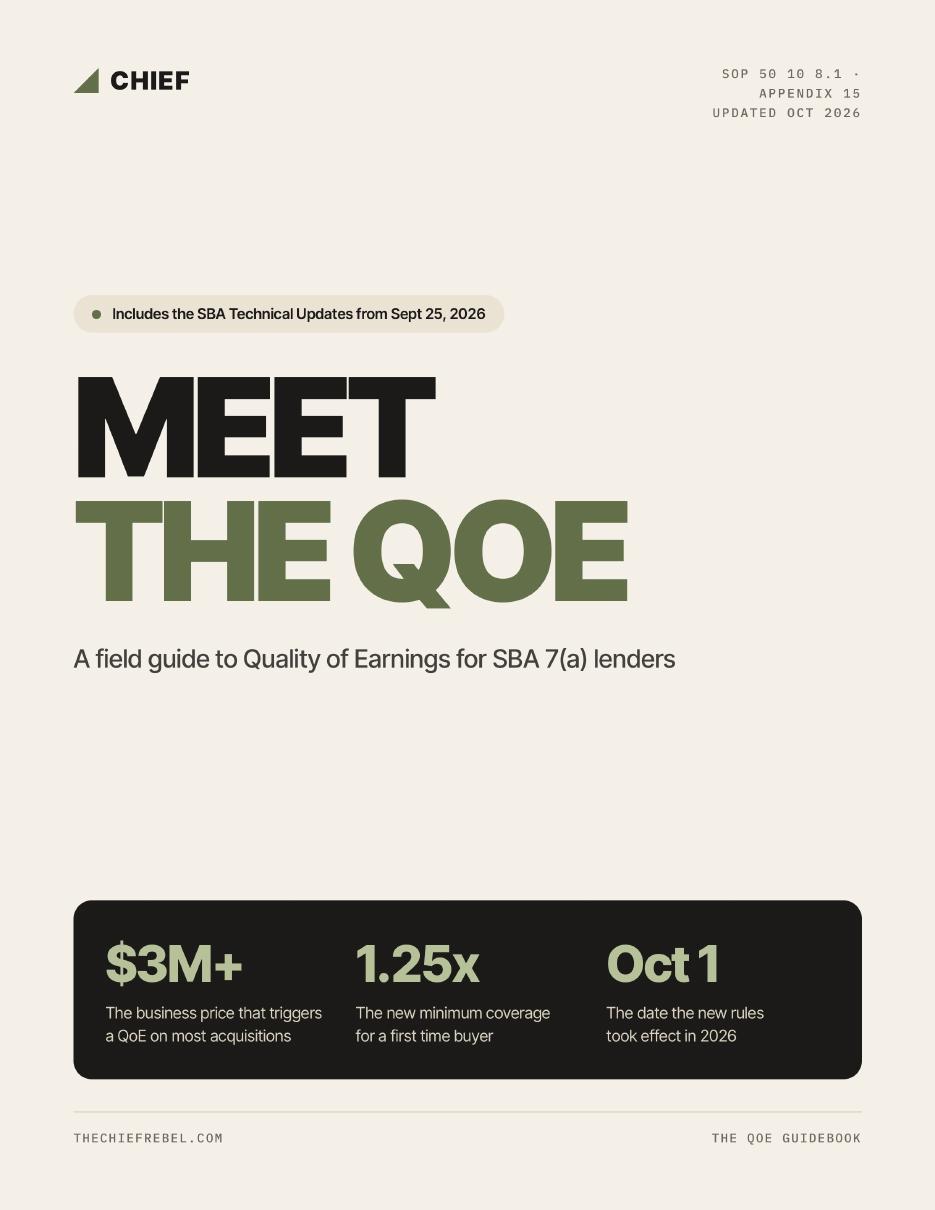
Lender field guide
Meet the QoE
What SBA acquisition lenders should know about Quality of Earnings.
Quality of Earnings
Are earnings what you think they are?
- 01Start with reported earnings
- Bring the borrower financials together
- Reconcile reported earnings
- Establish the starting point for analysis
- 02Test the adjustments
- Review owner and one-time expenses
- Trace adjustments back to supporting evidence
- Separate supported adjustments from questionable ones
- 03See normalized cash flow
- Arrive at normalized earnings
- See the impact of accepted adjustments
- Carry the result into valuation and credit analysis
QUALITY OF EARNINGS
Harbor Manufacturing Co.
- Industry
- Metal fabrication
- TTM revenue
- $9.4M
- Periods
- FY24 · FY25 · TTM
TTM revenue
$9.4M
Reported EBITDA
$615K
EBITDA margin
6.5%
Operating cash flow
$538K
| Historical performance | FY 2024 | FY 2025 | TTM Jul 2026 |
|---|---|---|---|
| RevenueTax return · P&L | $8.1M | $8.9M | $9.4M |
| Gross profitP&L | $2.44M | $2.58M | $2.63M |
| Operating incomeP&L | $496K | $470K | $441K |
| EBITDAP&L · GL | $688K | $652K | $615K |
| Net incomeTax return | $362K | $331K | $298K |
REPORTED EBITDA · STARTING POINT
$615K
Reconciled to the FY 2025 tax return and TTM interim statements.
ADJUSTMENT REVIEW · TTM JUL 2026
Reported EBITDA $615K
| Owner compensationOwner-related · 2025 general ledger | SUPPORTED | +$120K |
| One-time legal expenseNon-recurring · Legal invoices | SUPPORTED | +$45K |
| Related-party rentRelated party · Lease agreement | SUPPORTED | +$35K |
| Non-recurring revenueRevenue quality · Sales ledger | SUPPORTED | −$22K |
| Vehicle expenseOwner-related · Bank statements | PARTIALLY SUPPORTED | +$18K |
| “Growth investment”Proposed addback · Management explanation | EXCLUDED | +$0K |
EVIDENCE
Owner compensation
- Borrower proposed
- +$120K
- Chief supported
- +$120K
- Status
- SUPPORTED
- Period
- TTM Jul 2026
SOURCE
ANALYST NOTE
Seller salary above the cost of a market-rate replacement GM.
Market replacement cost documented. Full amount supported.
Every adjustment is reviewed against source documents before it counts.
REPORTED EBITDA
$615K
SUPPORTED ADJUSTMENTS
+$196K
NORMALIZED EBITDA
$811K
EBITDA BRIDGE
Every adjustment changes the picture.
NORMALIZED CASH FLOW
Normalized EBITDA
$811K
Annual debt service
$605K
DSCR
1.34x
Debt / EBITDA
4.4x
Valuation earnings base $811K · indicated value $4.78M at 5.9x
NORMALIZED EBITDA
$811K
Valuation
Is the business worth what you think it is?
- 01IDENTIFY ACTUAL EARNINGS
- Bring the financials together
- Find one-time and owner-related expenses
- Turn reported earnings into normalized earnings
- 02See what it's worth
- Use more than one valuation method
- See the range, not just a single number
- Understand what supports the conclusion
- 03Test the purchase price
- Compare purchase price to concluded value
- See how the deal is financed
- Check coverage on normalized earnings
BUSINESS VALUATION
Harbor Manufacturing Co.
- Industry
- Metal fabrication
- TTM revenue
- $9.4M
REPORTED EBITDA
$615K
ADJUSTED EBITDA
$0K
$615K + $0K normalization adjustments
NORMALIZATION ADJUSTMENTS
| Owner compensation | +$120K |
| One-time legal expense | +$45K |
| Related-party rent | +$35K |
| Non-recurring revenue | −$22K |
| Vehicle expense (partial) | +$18K |
| “Growth investment” (excluded) | +$0K |
| Total adjustments | +$0K |
NORMALIZED EARNINGS DISTRIBUTION
VALUATION METHODS
- Income approachDiscounted cash flow$4.7M
- Market approachGuideline public companies$5.0M
- Comps approach17 private transactions$4.8M
ESTIMATED BUSINESS VALUE
···
Enterprise value · Normalized EBITDA $811K × 5.9x
PURCHASE PRICE
$5.1M
CONCLUDED VALUE
$4.8M
Price is 6.3% above concluded value
Inside the $4.5M to $5.2M range, near the top.
SOURCES OF FUNDS
- Senior loan$3.6M
- Seller note$580K
- Buyer equity injection$920K
- DSCR on $811K normalized···
Annual debt service $605K. Total sources $5.1M = purchase price.
THE LIVING CREDIT FILE
Grow deposits and reduce risk post-close.
Lenders can monitor the numbers as the business changes.
At underwriting
- Historical financials
- Normalized earnings
- Valuation
- Transaction structure
- Buyer profile
- Original risks
- Approved DSCR
- Supporting evidence
After close
- Current financials
- Actual cash flow
- Updated DSCR
- Material changes
- Variance from original assumptions
- Source evidence
As underwritten
Locked at approval
$811K
Normalized EBITDA
$4.0M
Business value
1.34x
DSCR
Relationship growth
The next opportunity may already be in the borrower data.
A lender often learns more about a business during acquisition underwriting than almost anyone else involved in the relationship. Chief preserves that intelligence and can help relationship teams see when the business changes in ways that may create a new banking need.
- Revenue growthWorking-capital linePotential relationship signal
- Accounts receivable growthLOC + treasury managementPotential relationship signal
- Cash balances increasingDeposits + treasuryPotential relationship signal
- Payroll growthPayroll + treasury servicesPotential relationship signal
- Equipment investmentEquipment financePotential relationship signal
- New locationCRE + equipment + treasuryPotential relationship signal
- Another acquisitionAcquisition financingPotential relationship signal
- Debt moved elsewhereRefinance / relationship recapturePotential relationship signal
- Approaching maturityRefinance conversationPotential relationship signal
Chief can identify
- What changed
- Why the change may matter
- Which original assumption changed
- What type of banking need may be relevant
- What evidence supports the signal
The banker decides
- Whether the signal is meaningful
- Whether to contact the borrower
- Which product is appropriate
- Whether to extend additional credit
- What terms to offer
No automated solicitation. No automatic credit offers. No automatic servicing decisions.
From first loan to broader relationship
Give the BDO a reason to come back after closing.
The acquisition is often the beginning of the banking relationship, not the end. Chief can preserve the financial context from underwriting and surface operating changes that give a BDO a reason to reconnect with the borrower.
- Acquisition loan
- Living Credit Record
- Borrower grows
- Chief surfaces meaningful change
- BDO reviews potential banking need
- Relationship conversation
Before close
- Clearer valuation
- Clearer QoE
- Fewer diligence gaps
- Stronger acquisition conversation
After close
- Know what was originally underwritten
- See material business changes
- Identify potential financing needs
- Identify potential treasury / deposit opportunities
- Prepare for the next borrower conversation
Structured from the start
Valuation and QoE reports as PDF, customized to bank workflows.
Chief turns acquisition documents into structured Valuation and Quality of Earnings intelligence, delivered as a lender-ready PDF, structured data, or API.
Source data
CHIEF
Valuation + QoE intelligence
Structured fact
Revenue
$9.4M
TWO OUTPUTS
PDF report
Lender-ready file for the credit memo
API / structured data
The same figures, machine-readable
Tap a document to trace a number back to where it came from.
Works with your process
Start with the credit file you've already built.
Chief can provide you with valuation and quality of earnings or work with existing reports.
Bring your own valuation or QoE
Existing third-party valuation, QoE, credit memo, financial statements, projections, and transaction documents can be used to establish the original underwriting baseline.
One borrower record, two jobs
See what changed, whether it creates risk or opportunity.
Better credit intelligence and more valuable borrower relationships come from the same baseline. Current financials are read against what was underwritten, so material changes surface with their source. Credit, servicing, and relationship decisions stay with the bank.
What Chief does not require
Nothing the bank runs today has to change.
- No LOS replacement
- No core write access
- No automated credit decision
- No automated servicing action
- No requirement to replace existing valuation/QoE providers
QoE field guide
Trying to determine what a Quality of Earnings should actually include?
Read Chief's field guide for SBA lenders.
Start small
Start with one file.
01
Send the acquisition file
- Financial statements
- Tax returns
- Purchase agreement
- Existing valuation/QoE if applicable
02
Chief builds the analysis
- Normalized earnings
- Valuation
- QoE
- Source-linked findings
03
You gets a baseline that meets SBA standards
- Analysis ready for underwriting
- Preserved for future comparison